
.svg "logo")

This month, we take a closer look at the City of Stockholm and Netflix, two contrasting buyers whose approaches to the voluntary carbon market reflect both its maturity and its evolving breadth, from an established, quality-led corporate program to a city making its market debut with a landmark purchase of permanent removals. Combining AlliedOffsets data with wider research, we explore how their VCM activity, credit preferences, and decarbonization strategies have developed over time.
Buyer Spotlight

The City of Stockholm makes its first ever appearance in the voluntary carbon market this month, and it has done so in style, recording a single offtake deal of 750,000 credits on May 26th, instantly making it the largest new buyer tracked on the AlliedOffsets platform in May 2026.
Retirements by offset type
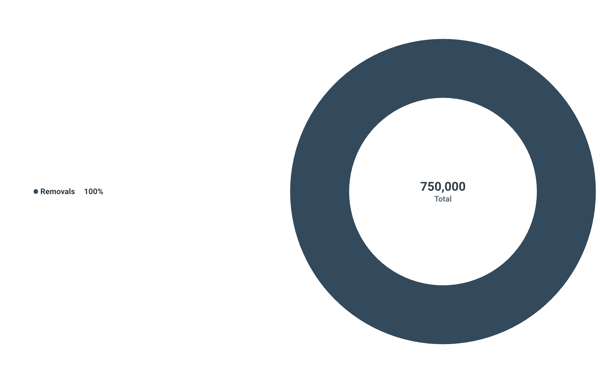
The transaction is not a standard retirement. Stockholm has signed a forward offtake deal with Stockholm Exergi, its own municipal energy utility, for credits from the Värtan BECCS facility, a project that will not be operational until 2028. The credits are pending on the registry, meaning Stockholm is pre-purchasing future removal credits rather than retiring existing ones. All 750,000 credits are classified as removals, sourced entirely from BECCS, with the captured CO2 stored permanently beneath the North Sea.
The purchase sits directly within Stockholm's broader climate strategy. In its Environmental Program and Climate Action Plan, the City of Stockholm has established the goal of becoming climate positive by 2030 and fossil fuel-free by 2040, requiring territorial emissions to decrease sharply and removals to exceed emissions by 2030. Permanent removals are earmarked to compensate for residual emissions that cannot yet be eliminated through direct reductions, and by purchasing from Stockholm Exergi directly, the city is both securing the supply it needs and helping to finance the infrastructure that will generate it.
Stockholm Exergi's Värtan facility has attracted significant private sector interest. Microsoft has expanded its offtake agreement with the project to 5.08 million tons, and the Frontier coalition, which includes Alphabet, Meta, H&M Group and JPMorgan Chase, has committed $48.6 million in offtake agreements. Stockholm's decision to join them as a buyer of its own utility's credits is nonetheless something distinct, a city using the voluntary carbon market as a direct instrument of municipal climate policy. As Stockholm Exergi CEO Anders Egelrud put it: "They are now continuing to show the way for how municipalities, companies and others should act by combining strong emission reductions with the purchase of permanent negative emissions."
It is an entrance to the VCM that few could have predicted, and one that the market will be watching closely.

Netflix has been a consistent market participant since 2020, accumulating 114 transactions across six years and retiring over 4.2 million credits across 42 projects, with an estimated total portfolio value of $31 million. Its weighted average price of $7.80 per credit sits notably above the broader market average, reflecting a deliberate preference for quality over cost.
Netflix was not active in the market in May but this is entirely in keeping with how the company engages with the VCM. Rather than retiring credits on a rolling monthly basis, Netflix purchases and retires in concentrated annual batches, timed to its ESG reporting cycle. Its most recent transaction was in April 2026, when it retired credits across seven VCS projects in a single day, including VCS2738, VCS1395, VCS1408, VCS1055 and VCS2250 totaling over 900,000 credits. The same pattern was visible in June 2025 and April 2025. Netflix retires roughly 1 million credits each year against essentially 1 million tons of annual emissions, and that annual commitment is clearly executed in one decisive move rather than spread across the calendar.
Retirements by offset type
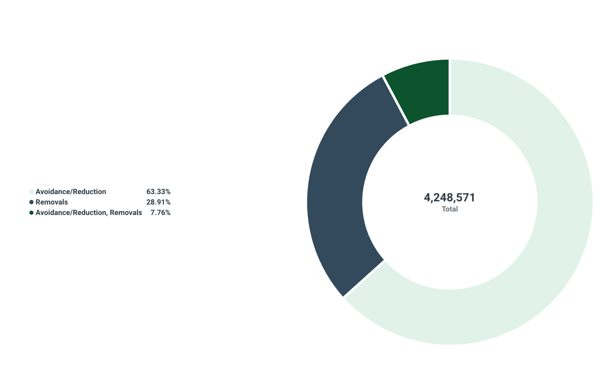
As the chart above illustrates, Netflix's portfolio skews heavily towards avoidance and reduction, though removal credits form a meaningful part of the mix. Forestry and land use dominates, accounting for over 80% of retirements. Its 2024 credit portfolio included REDD+ avoidance projects in Colombia and Kenya, improved forest management in California's Scott River basin, mycorrhizal-inoculated reforestation in Chile, and tidal wetland restoration in Pakistan, a geographically diverse set of projects spanning multiple ecosystems and methodologies. Its credits are also managed directly through Netflix's own registry accounts rather than via brokers, which is relatively uncommon and again speaks to the seriousness of its in-house approach.
What is particularly notable about Netflix's approach is its transparency. It is explicit that carbon credit retirements do not count towards its SBTi target progress, a level of clarity that remains uncommon among corporate buyers and lends real credibility to its reporting.
Netflix's longer-term supply strategy is also taking shape. In September 2025, it signed a 15-year contract with the American Forest Foundation to purchase verified credits from the Fields & Forests program, an afforestation and reforestation project targeting small landowners across the US South who have historically been priced out of the voluntary carbon market. By 2032, the program aims to enrol 75,000 acres and generate an estimated 4.8 million carbon credits. It is a sign that Netflix, like a growing number of established buyers, is moving beyond spot purchasing and beginning to shape the supply it needs for the long term.