
.svg "logo")
-1.jpg)
This month, we take a closer look at two contrasting buyers, Traxys and Postepay, highlighting their distinct approaches to engaging in the voluntary carbon market. Combining AlliedOffsets data with wider research, we explore how their VCM activity, credit preferences, and decarbonization strategies are evolving over time, from a global commodities trader posting its largest-ever month of retirements to an Italian payments and energy brand steadily scaling a renewable-backed offsetting program tied to its consumer energy business.
Buyer Spotlight

Traxys is a recent but immediately significant entrant to the voluntary carbon market, with retirement activity beginning in earnest around September 2025. Across three projects, it has retired 505,000 credits to date, an estimated $5.23 million in transaction value at a weighted average price of $10.83 per credit. July alone accounted for 400,000 of that total, up from a run rate closer to 50,000-60,000 credits a month in the prior year, making it Traxys' single largest month on the platform by a wide margin.
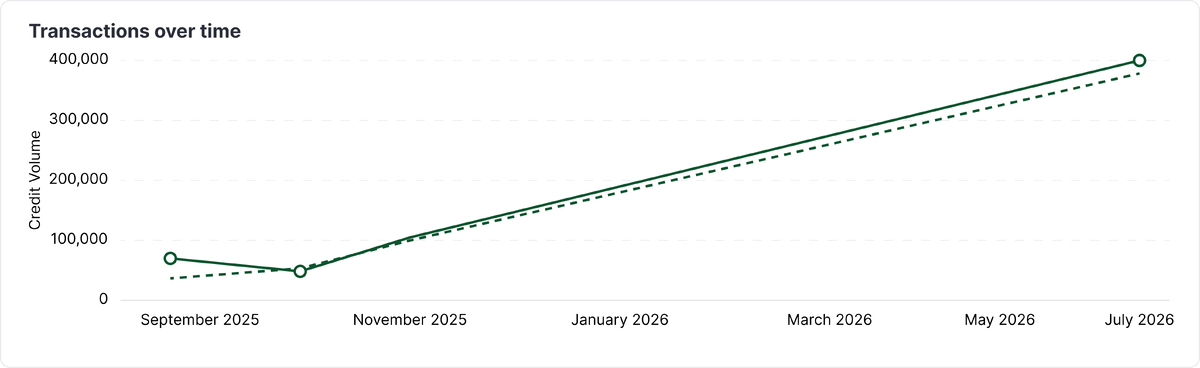
Traxys' portfolio sits entirely within avoidance and reduction credits, with no removals to date. By project type, agriculture-linked activities make up 79.2% of its retired volume, with the remainder split across chemical processes and industrial manufacturing categories. The average age of its retired credits has moved in the opposite direction to more mature corporate buyers: rather than trending toward older, established vintages, its average age has climbed from roughly 2.7 years for 2025 retirements to 4.2 years for 2026 retirements, suggesting a portfolio still being actively assembled rather than settled into a long-term sourcing pattern.
The retirement activity comes during a notably active year for Traxys more broadly. In April, the trader completed its acquisition of Carbomax AB, a Swedish ferroalloys and industrial materials specialist, extending Traxys' footprint in the Nordic green steel supply chain (Carbomax's "carbon products" line refers to carbon-based industrial inputs used in steelmaking, distinct from carbon credits). Traxys was also named earlier this year as one of three global trading houses selected to procure critical minerals for the US government's $12 billion Project Vault, its Strategic Critical Minerals Reserve program, and in July it closed a $2 billion upsized revolving credit facility - placing its first major push into the carbon market alongside a broader period of financial and operational expansion.

Postepay, the Italian payments and telecommunications arm of Poste Italiane, has retired 710,000 credits to date across 8 projects, an estimated $1.65 million in transaction value at a weighted average price of $2.33 per credit. July was its largest single month on record at 300,000 credits, roughly triple January's volume of around 100,000, following a pattern of retirements that dipped close to zero in 2023 before climbing steadily back through 2024 and 2025.
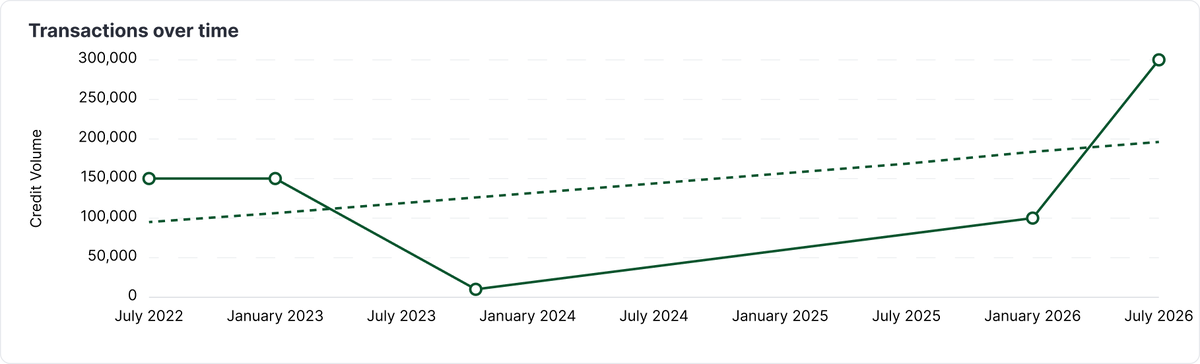
The activity ties directly to Poste Energia, the electricity and gas supply product Postepay has sold to Italian households since February 2023. Postepay commits to purchasing carbon credits equal to the greenhouse gas emissions released by the gas it sells, and by the first nine months of 2025 the offer had grown to serve over 950,000 domestic customers, generating roughly €76 million in energy-related revenue, a customer base whose growth lines up with the rising retirement volumes since.
Renewable energy accounts for 91.55% of Postepay's retired volume, split between wind and hydro project types, with the remaining 8.45% coming from household device (cookstove-type) projects. Postepay's own sustainability page names two wind projects developed by Green Infra Wind Energy Limited in India as part of its offsetting portfolio, consistent with the India-based project location on its buyer profile. All of its retired credits fall under avoidance and reduction, with no removals in the portfolio to date.