
.svg "logo")

Offtake volumes more than doubled in July on the back of the largest ethanol BECCS agreement announced to date, even as issuance, retirements, and investment all pulled back. The signal underneath the numbers: durable removals just picked up two of the most consequential structural tailwinds of the year, from the EU ETS reform proposal and SBTi's V2.0 standard.
The month in numbers
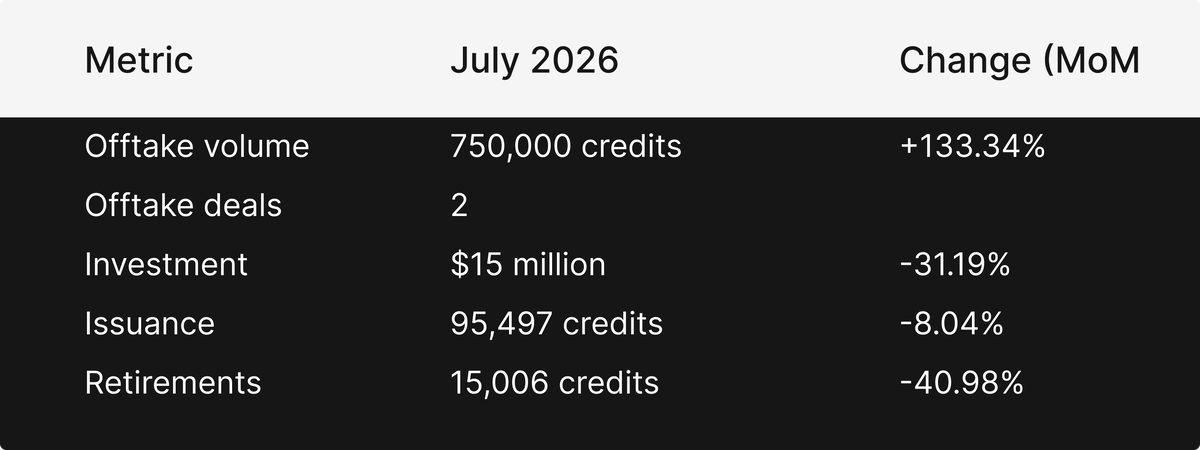
Deal activity concentrated almost entirely in two pathways this month: BECCS and biochar.
One deal reshaped the offtake market
July's contracted volume was dominated by a single agreement. Frontier Infrastructure Holdings and Carbonfuture entered a multi-year commercial partnership for 750,000 durable removal credits from Project Sprint, the largest ethanol BECCS carbon removal agreement announced to date. Captured biogenic CO2 will travel via Frontier's CO2-by-rail platform to permitted geologic storage in Wyoming, with sequestration expected to begin in Q4 2027.
That single deal explains the entire 133% jump in offtake volume this month, and it says something bigger about where BECCS buyers are placing confidence: multi-year, rail-connected, geologically permanent storage at scale.
The rest of July's contracted activity told a quieter but equally telling story. UK law firm Shoosmiths signed a five-year pre-purchase forward offtake with Carbonaires for durable biochar removals sourced from HUSK, a biochar producer operating across Cambodia and Vietnam, supporting the firm's zero net operational emissions target. Buyers outside BECCS are increasingly locking in supply years ahead through forward offtakes rather than competing for spot volume, a pattern AlliedOffsets has tracked building across the biochar market through 2026.
Investment stayed diversified even as totals dipped
Capital deployed into CDR fell 31.19% month-on-month to $15 million, but the geographic spread of that capital is worth noting. Biochar drew funding across three continents in July alone.
In Canada, the federal government committed CAD $7 million to a project converting biosolids from Greater Victoria's wastewater treatment process into biochar, with a facility planned at the Hartland Landfill site. In India, ProClime and Japan-based Cadira Capital Management signed an MOU to mobilize an initial $10 million toward seven biochar plants across six Indian states, projected to generate approximately 35,000 CDR credits per year once operational and certified under Puro.earth and Isometric. In Switzerland, Arrhenius AG closed a seed round to scale its microalgae-based Biomass Carbon Removal and Storage (BiCRS) process, growing microalgae in outdoor photobioreactors before drying and storing the carbon-dense biomass underground.
The month-on-month decline in total investment reflects deal timing more than waning appetite. Three separate biochar bets across three continents in a single month is not a market losing conviction.
Biochar still supplies most of the market
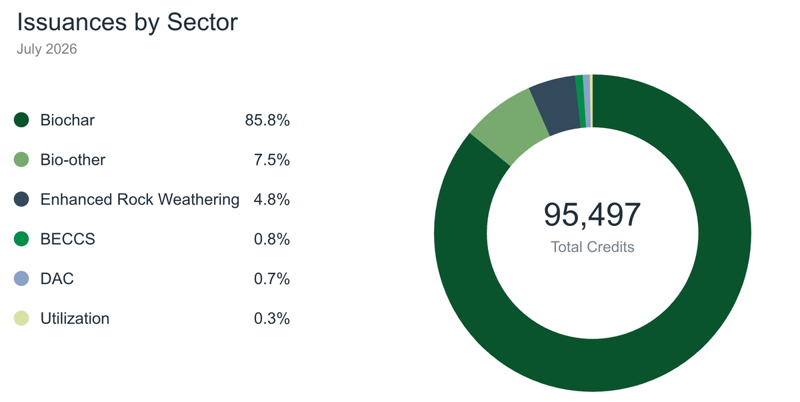
Total issuance reached 95,497 credits in July, down 8.04% from June. Biochar accounted for 85.84% of that supply, with Bio-other (7.52%) and enhanced rock weathering (4.81%) filling smaller shares. BECCS, DAC, and utilization pathways combined made up under 2% of the month's issued credits.
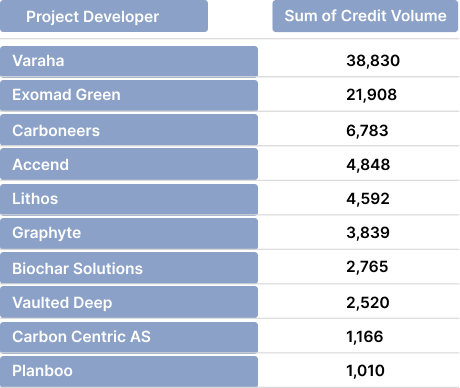
Varaha led all suppliers with 38,830.97 credits issued, followed by Exomad Green (21,908) and Carboneers (6,783.57).
The gap between issuance and offtake this month is the story worth watching. Biochar dominates what's actually being delivered today. BECCS dominates what buyers are committing to for the future. That gap between current supply and forward demand is exactly what the policy developments below are designed to close.
Retirements dropped, but the buyer list kept growing
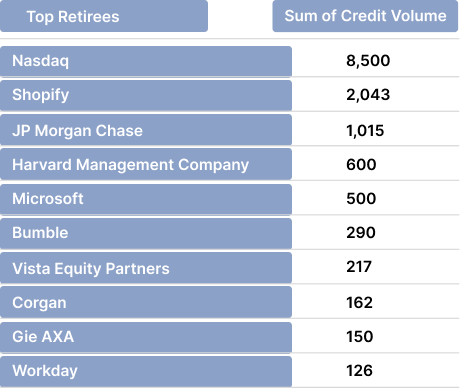
Retirements fell 40.98% month-on-month to 15,006.11 credits. Nasdaq retired 8,500 BECCS credits from Gevo North Dakota (the renamed former Red Trail Energy, LLC site in Richardton, North Dakota), more than half of the month's total on its own. Shopify (2,043.93) and JPMorgan Chase (1,015.35) followed. Harvard Management Company, Microsoft, Bumble, Vista Equity Partners, Corgan, AXA, and Workday rounded out the top ten.
A retirement list spanning financial services, tech, fashion, private equity, architecture, insurance, and enterprise software in a single month underscores how broadly durable removals have moved into mainstream corporate carbon strategy.
Policy: two frameworks just gave durable removals a funded future
EU ETS reform creates a buyer, but not enough supply
The European Commission's ETS reform proposal introduces Article 9c: auctioning 250 million additional EU ETS allowances (plus a 10 million reserve) between 2031 and 2040 to fund purchases of CRCF-certified permanent removals, administered by a new Removals Authority. Only BioCCS and DACCS qualify for now. Biochar and other nature-based approaches are excluded until at least a 2034 review.
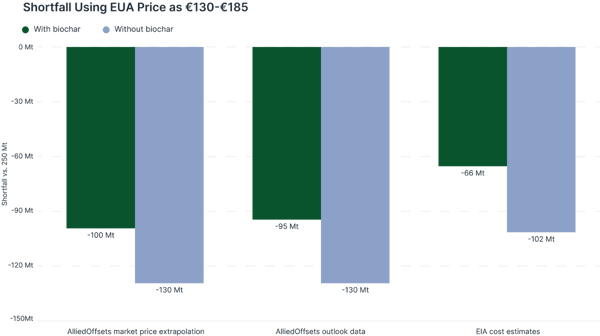
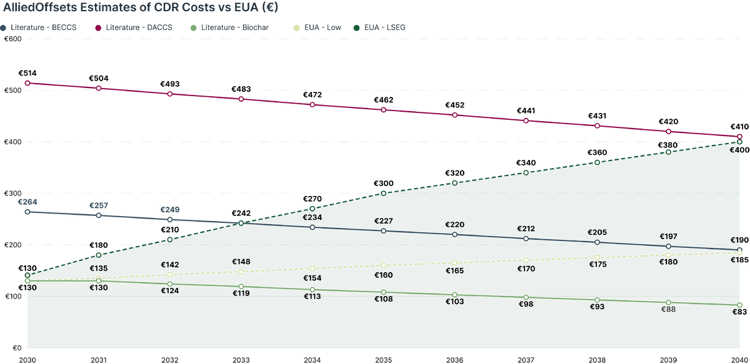
AlliedOffsets' own capacity data puts predicted EU BioCCS and DACCS output at just 5.6 million tonnes a year from 2030, roughly 56 million tonnes across the decade. That's a fivefold shortfall against the 250 million tonne funding target. The math gets more sensitive from there: at a more probable EUA price range of €130 to €185, modeling points to a supply deficit of roughly 130 million tonnes without biochar in scope, narrowing to about 95 million tons if biochar is admitted at the 2034 review.
In plain terms: the EU just built a funded buyer for durable removals nearly a decade before the market can plausibly fill the order.
SBTi V2.0 gives long-lived removals a permanent role
SBTi's Corporate Net-Zero Standard V2.0 formally introduces Ongoing Emissions Responsibility (OER), a three-tier framework recognizing high-integrity credits for companies taking financial responsibility for residual emissions ahead of their net-zero year. Long-lived removals like DACCS and BECCS sit at the top of the standard's quality hierarchy, addressing the separate C45 neutralization pool for hard-to-abate residual emissions at a company's net-zero year.
This is the first time a standard of SBTi's influence has codified a preference for permanence at this level of specificity, and it gives corporate buyers a clear framework for why durable removals belong in their portfolio now, not just at net-zero.
What it means
Two of the most influential frameworks in the carbon market, one regulatory and one voluntary, just pointed in the same direction: durable removals have a defined, funded role in the next decade of climate action. Neither creates demand that buyers need to act on tomorrow. What they create is certainty that the demand is coming, at a scale current supply cannot yet meet.