
.svg "logo")

This analysis was co-authored by Fundi Maphanga (Policy Lead), Maria Benzoni (Project Lead, Custom Insights), Pranav Balaji (CDR Analyst) and Sean Comiskey (Carbon Policy Analyst)
The European Commission published its proposal to reform the EU ETS for Phase V (2031-2040) on 17 July 2026, amending Directive 2003/87/EC and Decision (EU) 2015/1814.
This is the first part of a broader package; additional proposals on national 2040 targets, the full international credits integrity framework, and Governance Regulation amendments are expected later in 2026. Parliament and Council must finalize positions by the end of 2026; with the trilogues targeted Q1 2027 under the One Europe, One Market roadmap.
1. CORSIA AND AVIATION SCOPE
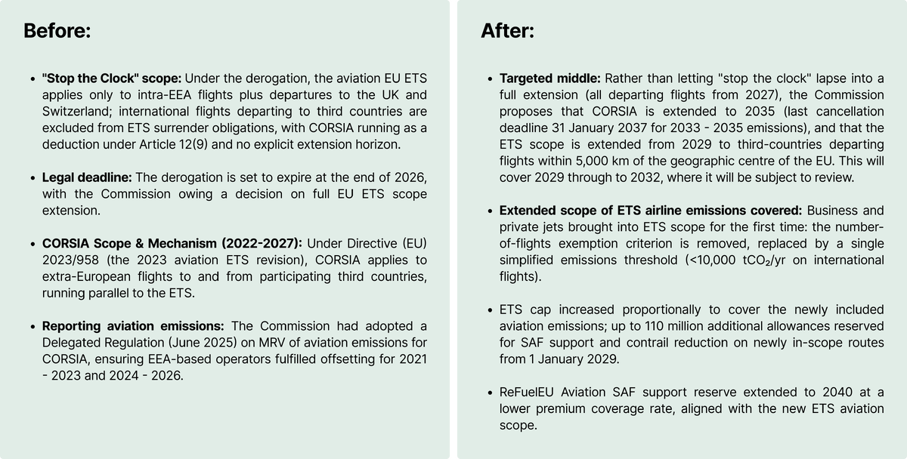
On the 17th of July, the European Commission’s assessment (Article 28b(2)) of CORSIA’s effectiveness found that participating states cover less than 70% of international aviation emissions, below the threshold that legally obligates the Commission to extend EU ETS scope to international departing flights.
Rather than triggering the full ETS expansion, the proposal maintains the EU's CORSIA implementation, the unit-cancellation mechanism under Article 12(9), through 2035, and limits the ETS scope extension to near-neighbourhood flights (≤5,000 km) from 2029, for four years subject to a 2032 review. The extension is contingent: the scheme must demonstrate ambition and >70% state participation by 2032, or the scope extension is reversed.
What this means for CORSIA
CORSIA demand will have to be assessed granularly, across countries: overlapping regimes based on geography, not distance from EU alone. Transatlantic flights stay fully out of ETS scope; similar-distance routes elsewhere (São Paulo ~9,800km, Nairobi ~6,300km, Delhi ~5,800km) fall inside it - an arbitrary-looking geographic split, not an emissions-based one.
The Phase 1 EEU Supply gap is not worsened by this reform, nor is it resolved
The EU Commission did not go ahead with applying additional quality thresholds and exclusions, a previous version of which meant excluding 84% of already eligible Phase 1 credits.
The authorization bottleneck
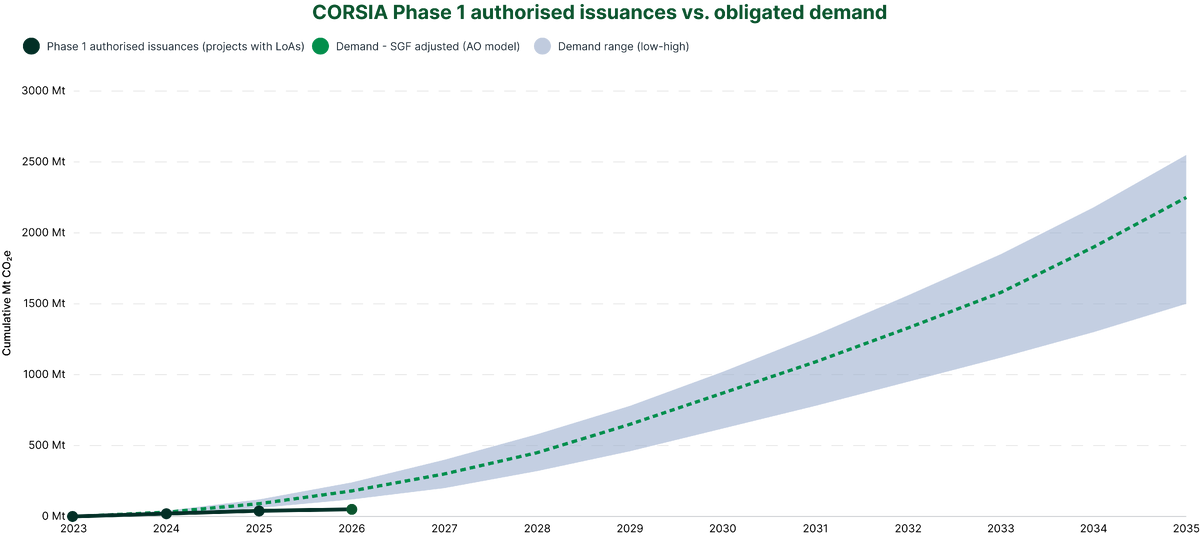
Cumulative CORSIA-authorized supply reached 51 Mt as of July 2026, of which Guyana's ART TREES jurisdictional REDD+ program alone accounts for roughly half. Against SGF-adjusted Phase 1 demand of ~200 Mt (2024–2026 emissions), authorized issuances cover only about a quarter, and the concentration in a single host country compounds the shortfall: supply is not just thin but narrow. The binding constraint remains authorization, not just underlying credit volume: on a program-eligible basis (no corresponding adjustment attached) far more supply exists, but it is non-conforming for compliance until an LoA and CA are in place.
2. CARBON REMOVALS INTO THE EU ETS
The proposal resolves the much-asked question of the legal role of domestic removals under the EU ETS.
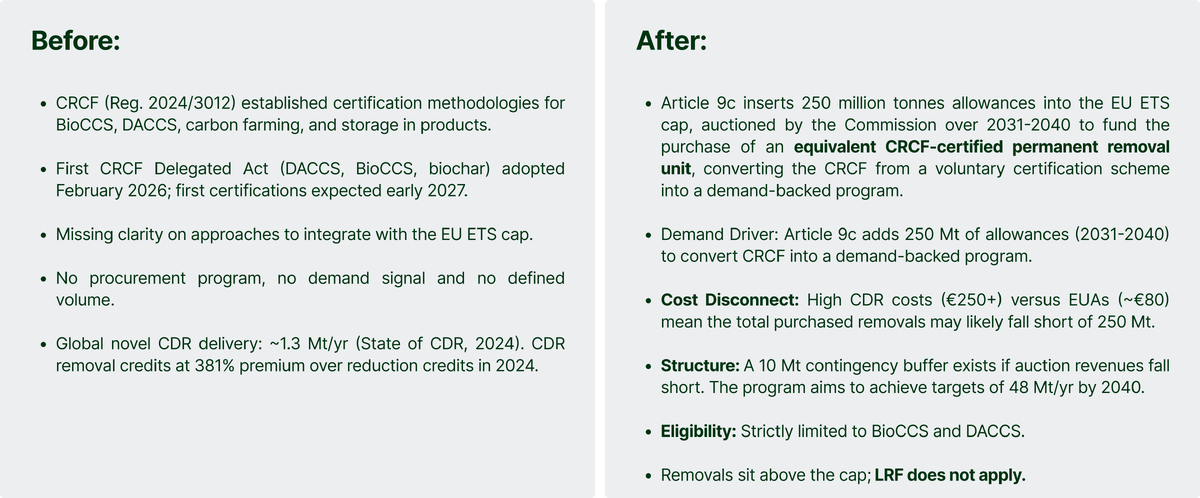
CRCF (Reg. 2024/3012) created a certification framework for carbon removals but left the demand question open, with the Buyer’s club still in development stages. The EU ETS reform intended to settle matters such as the manner of removals integration into the EU ETS, proposals for a procurement program and any signals on volumes of removals needed under the ETS.
COM(2026) 616 answers that question with a defined volume of EU Allowances (EUAs) (250 Mt + 10 Mt contingency), which would be added to the cap and auctioned by the Commission. These are not directly the volume of removal units which The Commission will procure. Auction proceeds would fund the purchase of CRCF-certified removals, so the actual tonnage of BioCCS and DACCS will depend on the clearing price of allowances depending on what is bought, and willingness to pay.
The proposal does identify the EU Commission as the defined buyer (under the Removals Authority), of DAC and BECCS CDR, clarifies the window of procurement (2031–2040), and defines a demand signal of volumes required (48 Mt/year by 2040).
BioCCS and DACCS removals are eligible for now, both requiring permanent geological storage, with carbon farming, biochar, and temporary nature-based removals excluded until at least the 2034 review. From a carbon budgeting perspective, carbon removal units will be treated as sitting “above the cap” of the EU ETS, meaning that the declining volume of the ETS e.g. newly adopted change to the Linear Reduction Factor (LRF) does not apply to them.

What this means for EU-based CDR
Stable demand: The Commission becomes a central purchaser via a new Removals Authority, superseding the voluntary EU Buyers' Club as the primary near-term demand instrument. Purchases use competitive allocation where feasible, with payment on delivery of certified units.
BioCCS, DACCS eligibility until 2034, biochar under voluntary demand until then: The proposal restricts integration strictly to BECCS and DACCS through 2034, leaving biochar out of compliance with demand stability for the time being, despite meeting permanent removal methodologies under the CRCF.
Our reading is that this restriction is likely driven by carbon accounting durability concerns, bioenergy’s sustainable land-use debates, and CCS’s pre-existing regulatory presence within the ETS since 2009 (Directive 2009/31/EC recognized CCS as “not emitted” within ETS carbon accounting). Biochar has no equivalent legal standing, and would require a new accounting framework rather than altering an existing one.
From a carbon accounting lens: sitting outside the EU ETS cap means the Linear Reduction Factor (LRF) does not apply to these removals. Furthermore, market participants must contend with price convergence issues, as EU Allowances are not equal to one CDR unit.
3. INTERNATIONAL CREDITS
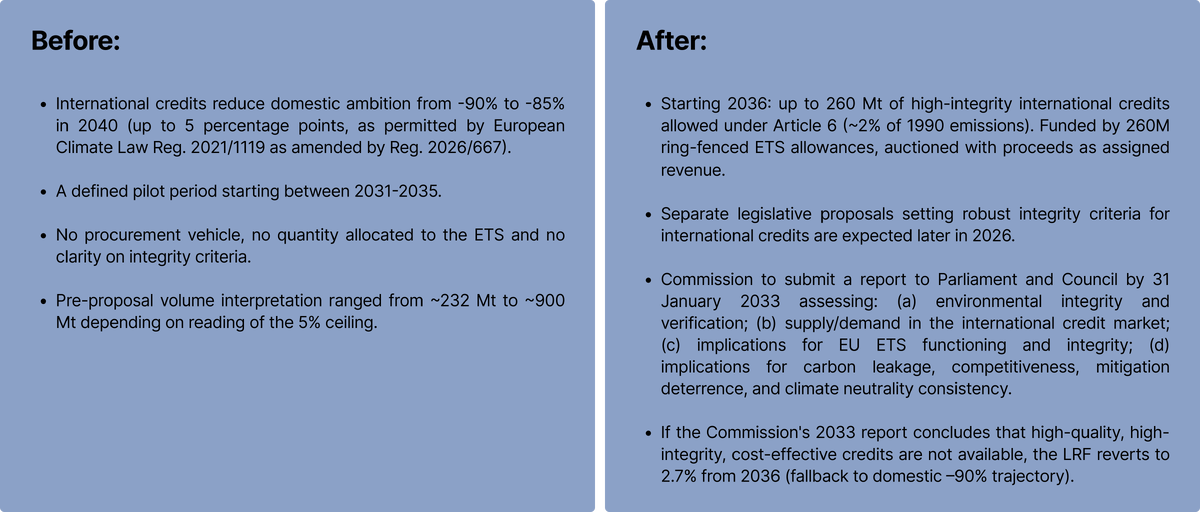
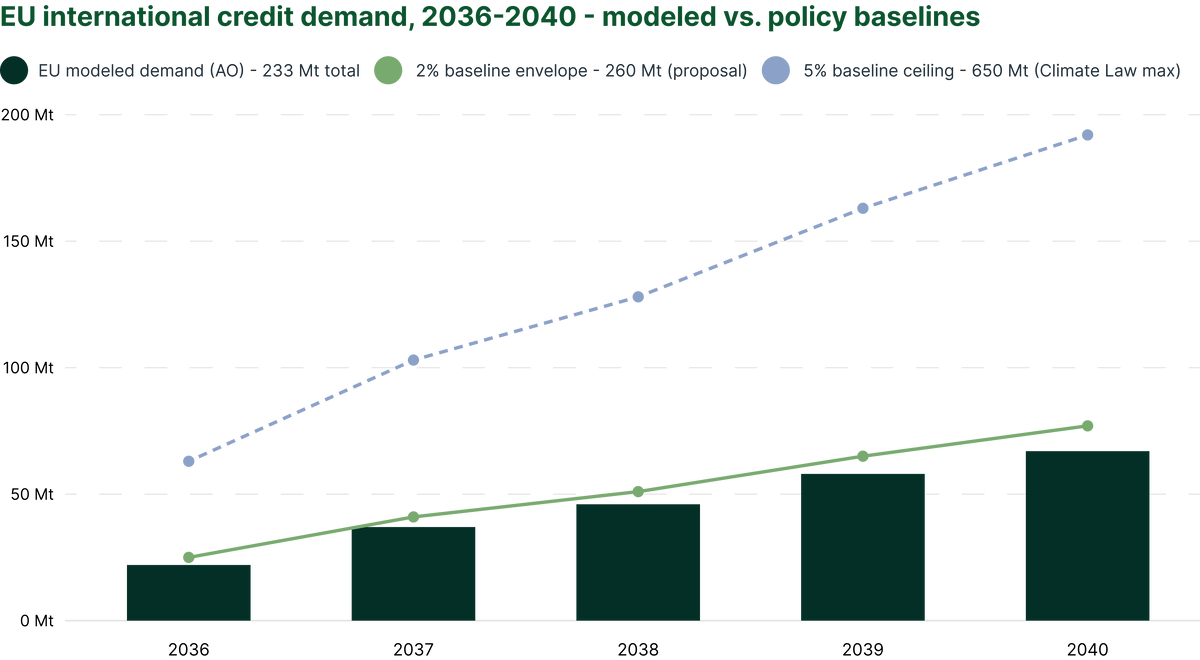
The European Climate Law (Reg. 2021/1119, as amended by Reg. 2026/667) created significant market speculation by setting a broad ceiling of up to 5% of 1990 net emissions in international credits starting in 2036. Interpretations of this ceiling varied wildly, ranging anywhere from 232 million to 900 million tonnes depending on the baseline model used.
With COM(2026) 616, the European Commission has provided much-needed clarity by capping the ETS allocation strictly at 260 million tonnes total over the 2036-2040 period.
The Commission’s decision to anchor the ETS quota to a 2% baseline rather than the full 5% ceiling sends a direct signal to global carbon markets: spot-market procurement of high-volume, high-integrity credits simply will not be feasible given current market supply.
What this means for the Article 6.2 market
- The EU becomes the market's dominant institutional buyer: 260 Mt over 2036–40 (~52 Mt/yr) is roughly 78% of tracked global demand by 2040, and equivalent to a full year of current CCP-labelled VCM supply squeezed into five years.
- Tight execution window: developers need to contract supply years ahead of 2036, but the integrity criteria (and the 2033 go/no-go review) won't be finalized in time, a 2–3 year window to commit capital against rules not yet written.
- Financing is self-contained: 260M ETS allowances auctioned, proceeds ring-fenced as assigned revenue for credit purchases.
- Real cliff-edge risk: if the 2033 review finds insufficient high-integrity supply, the LRF snaps back to 2.7% (strict domestic -90% path) and unused allowances get redirected to the Industrial Decarbonization Bank - so the whole mechanism could unwind with only ~3 years' notice.