
.svg "logo")

Spot, forward, and offtake are the three ways carbon credit pricing actually works in practice, and each one prices a different kind of risk. Buy the same ton of carbon dioxide through each and you can end up paying wildly different prices for it. That's not a market failure, it's three distinct procurement mechanisms doing three different jobs.
The AlliedOffsets500 index, which tracks average pricing across the broader spot market, has climbed from around $3.50 per ton in early 2024 to roughly $7 per ton as of July 2026. Compare that to the technical carbon removal segment, where the all-time average price paid via offtake sits at $587 per credit. Same voluntary carbon market, priced more than 80 times apart depending on what you're buying, and how far ahead you're buying it.
For buyers building a carbon strategy, understanding why that gap exists, and which mechanism fits their needs, matters more than chasing the lowest headline number.
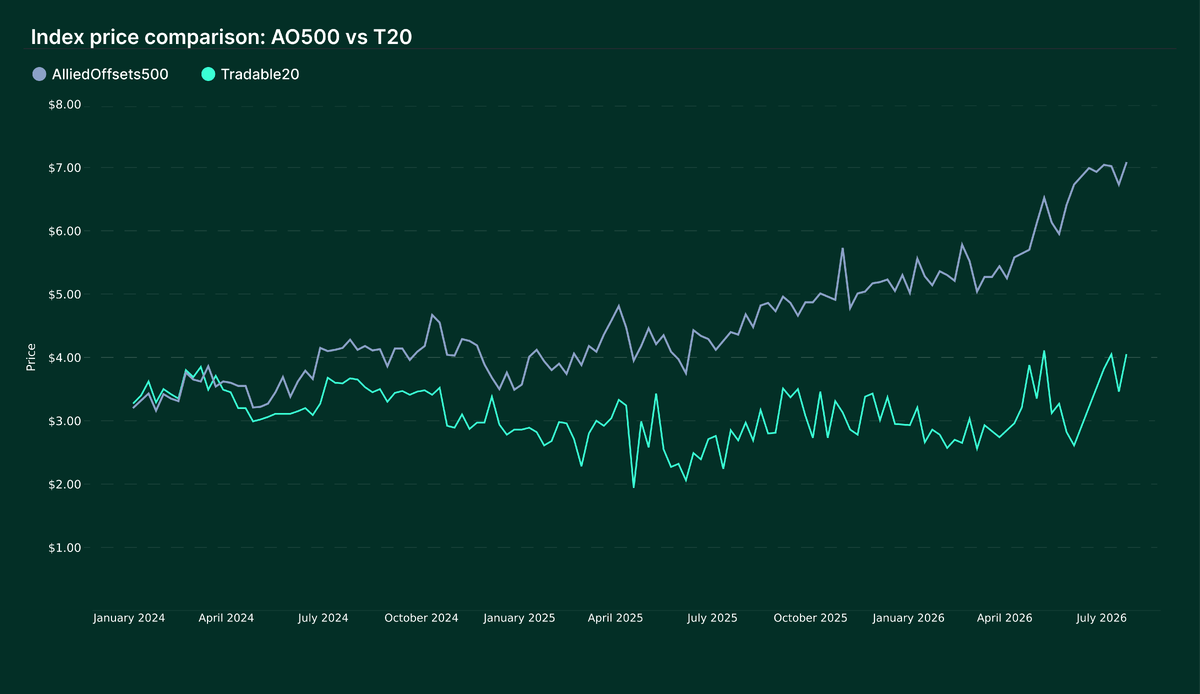
Source: AlliedOffsets500
Spot: buying what already exists
A spot purchase means the credits have already been verified, issued, and are available for immediate retirement. The buyer pays on the day and the credits are retired within days or weeks.
Spot is where most of the market's volume still sits. AlliedOffsets recorded 394 million tCO2e retired in 2025, up 2% year-on-year, the bulk of it credits bought and retired at spot. But an index average like AO500 hides enormous variation underneath it. Project type, methodology, vintage, and quality rating all move the price, and the highest-integrity categories are becoming harder to find on the spot market at all, because they've already been claimed through longer-term agreements before they ever reach it.
Spot suits buyers with smaller or variable annual volumes, buyers new to the market who want to see exactly what they're purchasing before committing further, and buyers filling a residual gap once a longer-term procurement program is already covering the bulk of their needs. The trade-off is exposure: no certainty that the credit type or price you want will be available next year.
Forward: buying before the credits exist
A forward purchase locks in a price today for credits that will be issued at a future date, often while the underlying project is still under development. The buyer takes on delivery risk (the project may issue late, or issue less than expected) in exchange for a price that's typically 15 to 30 percent below the buyer's expected spot price at delivery, as multiple market sources note.
That discount is the developer's cost of capital. Projects, especially removals and high-integrity avoidance projects, need financing to get built. A forward buyer is effectively providing some of that financing upfront, and the price reflects the risk being shifted from the developer to the buyer.
Forward pricing is still a relatively new and thin part of the market compared to spot. Public, indicative forward pricing in particular is rare. Most forward deals are negotiated privately and never published, which makes it difficult for buyers to know whether the terms they're being offered are reasonable.
Offtake: buying supply, not just a price
Offtake agreements extend the forward concept across multiple years. Rather than locking in one delivery date, an offtake agreement secures a defined volume of credits annually over a project's lifetime, sometimes on fixed pricing, sometimes on a schedule that escalates as the project matures.
Offtakes tend to sit later in a project's life than pure forwards, once financing risk has partly been de-risked by earlier funders, which is one reason they're often considered lower risk than an early-stage forward. For buyers, the appeal is straightforward: a defined, multi-year supply of a specific credit type at a known cost, in a market where high-quality supply is expected to tighten as demand from serious corporate buyers grows.
AlliedOffsets recorded a 260% year-on-year jump in offtake transaction volume in 2025, reaching roughly 158 million tCO2e, against just 2% growth in overall retirements over the same period. Offtakes are still a smaller slice of total market activity than spot, but they're the part growing fastest by far. That's a signal in itself: buyers are increasingly willing to commit now to guarantee access to specific, high-integrity supply later.
Why the gap is useful information, not a red flag
A spread that size between spot and offtake pricing tells buyers something real about where the market thinks quality and scarcity are heading. Spot prices reflect what's available and tradeable right now. Forward and offtake prices reflect what buyers are willing to commit to secure specific supply years in advance.
Neither number is "the" carbon price. They're two different answers to two different questions: what can I buy today, and what do I need to guarantee for tomorrow. A buyer building a credible, long-term procurement strategy typically needs visibility into both, and needs to know which mechanism they're looking at before comparing prices across it.
A tool for the deal, not a replacement for the people who close it
None of this replaces the role brokers play in the market. Seeing indicative pricing publicly is useful for narrowing down what fits a buyer's budget and vintage requirements, but it doesn't negotiate a price, execute a deal, or draft a contract. That part of the process, structuring terms, verifying delivery, closing, still runs through the same relationships it always has.
For brokers and traders, that makes AlliedCredits a sourcing aid rather than something to compete with. It's a faster way to see where the market already sits before doing the work that only a broker can do: matching the right credit to the right buyer, and getting the deal actually done. The goal is to give everyone, buyers, brokers, and developers alike, a clearer starting point, not to cut anyone out of the process.
See all three, side by side
The clearest way to work out which mechanism fits your strategy is to see live pricing across spot and forward listings in one place, rather than piecing it together deal by deal. That's what's on AlliedCredits: take a look and see how the three compare in practice.
