
.svg "logo")
-1-1.jpg)
The carbon removal market recorded a strong end to the first quarter in March, with activity increasing across all key segments of the CDR market. Offtake volumes surged significantly month-on-month, driven by several large biochar agreements, while issuance also saw a sharp increase.
Investment activity dipped compared to February but remained steady, with continued capital flowing into BECCS, biochar, utilization, and mineralization pathways. This suggests continued underlying activity despite the month-on-month decline.
At the same time, retirements rose substantially, pushing the retirements-to-issuance ratio to 49%, indicating improving demand absorption alongside rising supply.
At a quarterly level, Q1 2026 recorded over 1.7 million tonnes in offtake agreements, 281,000 credits issued, and 116,000 credits retired, underscoring strong contracting activity alongside steadily increasing supply and demand absorption.
Overall, the month was characterized by high volumes across offtakes, issuance, and retirements, with biochar continuing to play a central role in both supply and contracting activity, alongside increasing use of portfolio-based procurement structures across buyers.
Monthly highlights
- Offtake: 1,505,040 credits across 9 deals (MoM +667.09%)
- Investment: $22.6 million (MoM -42.55%)
- Issuance: 151,296 credits (MoM +278.14%)
- Retirements: 74,738 credits (MoM +238.13%)
Offtake
Offtake activity totalled 1,505,040 credits across nine disclosed transactions during the month, representing a significant increase of 667% month-on-month.
Biochar dominated contracted volumes this month, with several large-scale agreements driving activity. Microsoft signed the largest deal, securing 1 million biochar credits from Liferaft, while Altitude announced a 305,000-tonne agreement with Empacar in Bolivia, highlighting continued scaling of high-integrity supply. Google also contributed significantly, contracting 200,000 tonnes with AMP Sortation, further reinforcing biochar’s role in waste-to-value pathways. Zephyr additionally signed a deal with Carbon Centric for BECCS credits.
Aviation and industrial buyers remained active, with Boeing signing a 40,000-tonne multi-year agreement via Carbonfuture and Mercedes-AMG PETRONAS contracting 18,900 tonnes through CUR8. At the same time, developers are increasingly signing offtake agreements with marketplaces and facilitators to reach end buyers, as seen in deals involving Octavia Carbon (via Carbon Direct) and Sirona Technologies (via Patch).
Structured, portfolio-based approaches are also becoming more common. Pension Insurance Corporation (PIC) expanded its CDR exposure through CUR8, sourcing a mix of credits across mineralization (OCO Technology), DAC (1PointFive), and biochar (Carboneers). In parallel, a buyers’ collective transaction with Stockholm Exergi, structured by ClimeFi, marks the first publicly announced CRCF-aligned removal unit.
Overall, these trends point toward a market increasingly organized around portfolios of suppliers and portfolios of buyers, rather than one-to-one bilateral offtake agreements.
Investment
Total disclosed investment reached $22.6 million during the month, down 42.55% month-on-month.
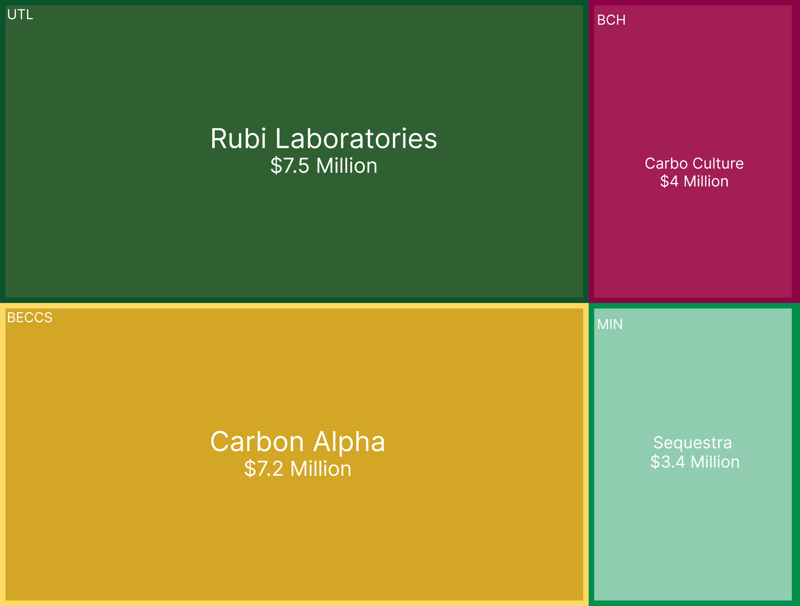
Utilization-focused companies captured the majority of funding this month, led by Rubi Laboratories, which raised $7.5 million from a consortium of investors including AP Ventures, FH One Investments, H&M Group, and Talis Capital to scale its CO₂-to-materials technology.
Public funding and grants also played a key role. Carbo Culture secured approximately $4.1 million from the Netherlands Enterprise Agency (RVO) to advance biochar development, while the Government of Canada supported multiple projects, including $7.2 million for Carbon Alpha (Svante) and $0.5 million for CarbiCrete, targeting BECCS and mineralization pathways respectively.
Other notable investments included $3.4 million raised by sequestra, a mineralization-focused developer.
Overall, investment activity declined compared with the previous month but remained concentrated across utilization, biochar, and mineralization pathways.
Issuance
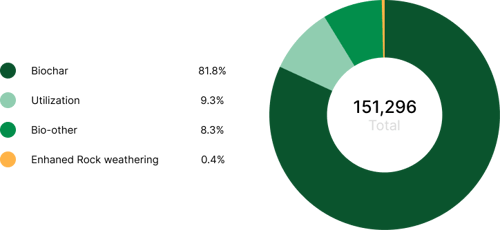
Total issuance reached 151,296 credits during the month, up 278.14% month-on-month.
Issuance activity this month was again dominated by biochar projects, which accounted for the majority of credits generated.
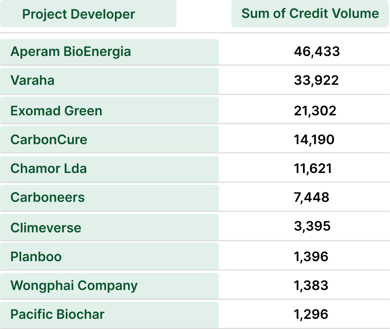
Aperam BioEnergia led issuance with over 46,000 credits, followed by Varaha with nearly 34,000 credits and Exomad Green with over 21,000 credits. Biochar developers collectively represented the largest share of supply entering the market.
Other biochar projects, including Carboneers, Climeverse, Planboo, Wongphai Company, and Pacific Biochar, contributed smaller volumes, reinforcing the breadth of issuance across the pathway.
Beyond biochar, limited issuance was observed from other pathways. CarbonCure generated over 14,000 credits from utilization-based projects, while Cânhamor Lda contributed over 11,000 credits under bio-based carbon storage.
Overall, issuance growth was driven primarily by biochar, with relatively limited supply from other carbon removal pathways.
Issuances by Sector
Retirements
Total retirements reached 74,738 credits during the month, increasing 238.13% month-on-month.
The significant rise in retirements reflects growing demand for carbon removal credits alongside increasing market activity. Despite this increase, retirements continued to lag new supply, with the retirements-to-issuance ratio standing at 49%.
Overall, the increase in retirements indicates improving demand absorption, though a gap between credit generation and utilization remains.
![]](https://blog.alliedoffsets.com/hs-fs/hubfs/%5D.png?width=650&height=568&name=%5D.png)
Overall, this continued rise in retirements highlights strengthening demand signals in the market. To learn more about where future demand in the voluntary carbon market is emerging, explore our latest report on Future Buyers in the VCM, highlighting the sectors, companies, and regions set to drive the next wave of carbon credit purchases.