
.svg "logo")
-1.jpg)
Most conversations about CORSIA focus on credits, which ones qualify, where they come from, whether there are enough of them. What gets less attention is what actually happens when an airline doesn't comply. In the UK, that answer is increasingly clear: a £100 per ton of CO2 penalty, indexed for inflation. And paying the fine doesn't make the problem go away. The obligation to buy and retire the credits remains, the fine simply sits on top of it.
Two bodies share responsibility for making this work: the Department for Transport (DfT) owns the policy and legislative framework, while the Civil Aviation Authority (CAA) handles the monitoring, reporting, and verification side.
What the UK's enforcement framework actually looks like
The UK has been building toward this for a while. CORSIA's monitoring, reporting and verification requirements came into domestic law through the Air Navigation (CORSIA) Order 2021, and the DfT opened a consultation in December 2024 on the next piece, the offsetting obligations that require airlines to actually purchase and cancel credits, alongside how to handle the awkward overlap with the UK Emissions Trading Scheme.
One thing worth understanding is that the compliance process isn't a single step. Airlines need to submit verified CO2 emissions data to their competent authority by 30 November 2027 before they can retire credits against that figure by the 31 January 2028 deadline. Turning up in January 2028 with a stack of credits and expecting to call it done won't work, the verification has to happen first, and that takes time.
The final legislation covering offsetting hasn't been enacted yet, but the structure and the sequence are already established.
The UK ETS overlap:the problem most airlines aren't talking about
Here's where things get interesting and where the UK diverges from almost every other jurisdiction in the world.
Airlines operating between the UK and the EEA or Switzerland are currently caught under both CORSIA and the UK ETS simultaneously. That means the same ton of CO2 could technically trigger both a CORSIA offsetting requirement and a UK ETS surrender obligation, what the DfT, in its own consultation, described plainly as "double charging."
The proposed fix is a hybrid approach where airlines can reduce their UK ETS obligation by the equivalent of their CORSIA requirement on those overlapping routes, so the same emission isn't regulated twice. The final shape of that legislation matters significantly for carriers with heavy European route exposure, and it hasn't been settled yet. Airlines registered in France, Brazil, or Singapore don't have this layer to navigate, it's a distinctly UK problem, and one that hasn't received nearly enough industry attention.
How the UK compares globally
The £100 per ton figure is one of the most clearly defined CORSIA penalties anywhere in the world. The more revealing story, though, is what's missing elsewhere.
The United States, one of the largest aviation markets on the planet, has no defined per-ton penalty for CORSIA non-compliance. Neither do several other major markets. The result is a compliance landscape that isn't level: a UK-registered carrier faces a concrete, quantified financial consequence for falling short, while a competitor flying the exact same route under a different flag faces something much closer to reputational risk.
That asymmetry is real, and the DfT flagged it explicitly in its consultation when raising the risk of "market distortions." For UK carriers, it's not just a regulatory nuance, it's a competitive one.
Why the timeline is tighter than it looks
First Phase ends in December 2026. The credit retirement deadline is January 2028. Thirteen months sounds like a comfortable runway. It isn't.
Credit procurement, registry processes, and the verification requirements all take time, and the supply picture adds another layer of pressure. The chart below shows where eligible supply actually sits today, and the concentration of credits across just three registries tells its own story about how constrained the market really is.
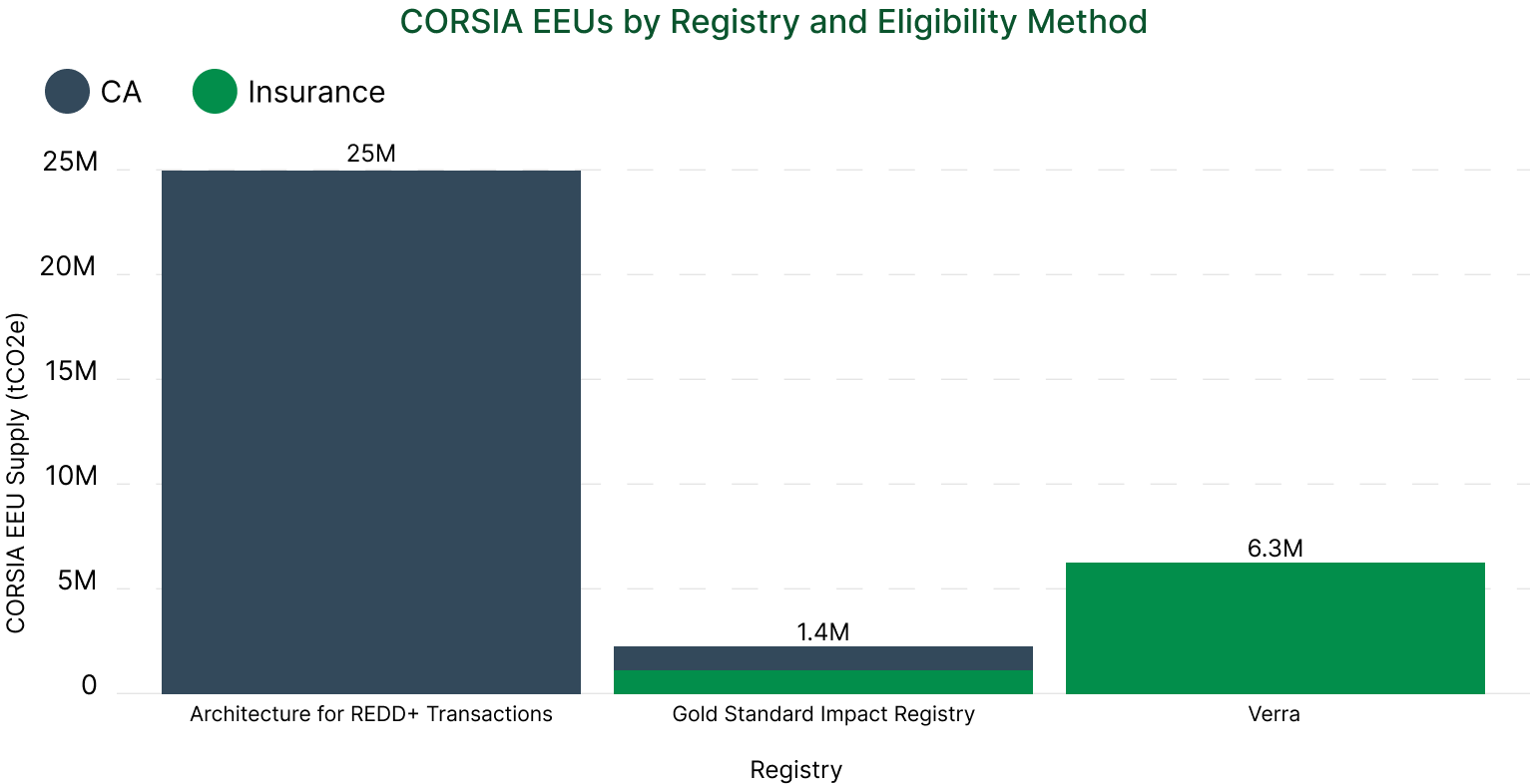
Source: AlliedOffsets & Artio CORSIA Market Forecast Report
Airlines that leave procurement until late 2027 may find the market has moved on both price and availability. With £100 per ton as the penalty floor, before the cost of the credits themselves, the economics of acting early are straightforward.
What this means for UK airlines
Of all the jurisdictions navigating CORSIA right now, the UK is one of the few where the enforcement picture is genuinely clear. The penalty exists, the regulators are named, and the ETS overlap, however complicated, is being worked through.
That clarity is useful, but it also raises the stakes. Airlines operating under UK registration can't claim confusion about what non-compliance costs or who is watching. The compliance sequence is defined, the deadline is fixed, and the credit market is the one variable that still has room to move and not necessarily in a helpful direction.
The enforcement framework is settled. What happens between now and January 2028 in the credit market is what will determine how costly compliance actually turns out to be.
For a deeper breakdown of supply constraints, insurance dynamics, and demand projections, explore the full AlliedOffsets and Artio CORSIA Market Forecast report here.